






Description
Climate Change Is Real – Unisex T-Shirt – Environmental Science and Climate Awareness
CLIMATE CHANGE IS REAL.
Not hidden in tiny print.
Not tucked into corner.
Written directly into smoke.
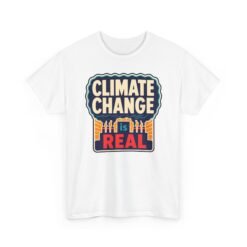
The Climate Change Is Real Unisex T-Shirt features a striking industrial scene with factory emissions rising into the sky and forming the words:
“CLIMATE CHANGE IS REAL.”
It’s simple.
It’s unmistakable.
And the artwork connects the message directly to one of the central subjects in climate science: human-generated greenhouse-gas emissions and their effect on Earth’s climate.
NASA reports that multiple lines of scientific evidence show Earth is warming and that human activities—particularly greenhouse-gas emissions—are driving the current warming trend.
The IPCC’s Sixth Assessment concluded that human influence has unequivocally warmed the atmosphere, ocean, and land.
This shirt puts that scientific subject front and center.
Why You’ll Love It:
- Bold “Climate Change Is Real” Design – Industrial emissions form the message directly within the artwork.
- Science-Inspired Environmental Graphic – A visual connection between human activity, atmospheric emissions, and climate.
- Clear, Minimal Message – No complicated slogan required. The design says exactly what it means.
- Made for Climate & Science Enthusiasts – A natural fit for people interested in environmental science, meteorology, Earth science, conservation, and climate research.
- Earth Day Ready – A relevant design for Earth Day events, environmental programs, science fairs, classrooms, and educational gatherings.
- Instant Conversation Starter – The smoke-based typography makes the environmental theme difficult to miss.
- Thoughtful Gift Idea – Great for science teachers, environmental-science students, researchers, conservation enthusiasts, Earth-science fans, and climate-science nerds.
Climate Change Is Real
Earth’s climate has always changed.
That’s true.
But that doesn’t mean every climate change has the same cause.
NASA explains that the current warming trend is different because human activities since the mid-1800s have produced greenhouse gases that trap additional energy in the Earth system.
Weather vs. Climate
Cold today?
That’s weather.
Hot tomorrow?
Weather.
Rain next week?
Weather.
Climate refers to longer-term patterns and averages.
Which is why:
“It snowed today.”
doesn’t answer a question about long-term global climate trends.
Different scales.
Different questions.
The Factory
Factory in the graphic isn’t subtle.
Stacks.
Emissions.
Smoke.
Sky.
Then:
CLIMATE CHANGE IS REAL.
Visual metaphor successfully delivered.
The Smoke
The graphic uses visible smoke to communicate the broader idea of industrial emissions.
In real climate science, the important warming agents include greenhouse gases such as carbon dioxide, methane, and nitrous oxide.
Not everything coming from smokestack has same atmospheric effect.
Science likes details.
Carbon Dioxide
CO₂.
Tiny molecule.
Enormous amount of research.
Carbon dioxide is naturally present in atmosphere and plays an important role in Earth’s climate.
Human activities have increased its atmospheric concentration substantially since Industrial Revolution.
The Greenhouse Effect
Without natural greenhouse effect, Earth would be much colder.
Problem isn’t that greenhouse effect exists.
It’s that increasing concentrations of heat-trapping gases change Earth’s energy balance.
Nuance matters.
The Thermometer
Scientists:
“Temperatures are changing.”
Internet:
“According to what?”
Scientists:
Thermometers.
Ocean measurements.
Satellites.
Ice cores.
Glaciers.
Sea-level observations.
Atmospheric measurements.
And several other lines of evidence.
Climate science has receipts.
The Satellite
Satellite:
Orbiting Earth.
Collecting data.
Watching clouds.
Measuring aspects of atmosphere, oceans, land, and ice.
Meanwhile:
You lose phone while holding it.
Technology has range.
The Ice Core
Scientist:
Pulls cylinder of ancient ice from enormous depth.
You:
“Cool ice.”
Scientist:
“This contains information about past atmosphere and climate.”
You:
“Extremely cool ice.”
The Tree Ring
Tree:
Grows.
Scientist:
Interesting.
Tree:
Grows again.
Scientist:
Still interesting.
Turns out natural archives can preserve information about past environmental conditions.
The Ocean
Most of Earth’s excess heat associated with global warming has gone into oceans.
Which means climate isn’t only about air temperature.
Atmosphere.
Ocean.
Land.
Ice.
All connected.
Earth refuses to organize itself into convenient independent departments.
The Glacier
Photograph.
Wait years.
Photograph again.
Compare.
Long-term observations matter.
Sea Level
Warmer ocean water expands.
Melting land ice adds water.
Global mean sea level responds.
Physics remains annoyingly consistent.
The Climate Scientist
Person:
“What do you do?”
Scientist:
“I study climate.”
Person:
“So can you tell me if it’ll rain Saturday?”
Scientist:
Different department.
The Meteorologist
Climate scientist:
Long-term patterns.
Meteorologist:
Weather and atmosphere.
Internet:
Calls both when temperature does something interesting.
The Forecast
Weather forecast:
Bring umbrella tomorrow.
Climate projection:
Entirely different scale and purpose.
Please do not ask climate model whether picnic needs umbrella at 2:15.
The Model
Person:
“So climate models are just guesses?”
Scientist:
No.
Models use physical laws, observations, and mathematical representations of climate system.
Person:
“So giant spreadsheet?”
Scientist:
Please leave laboratory.
The Data
Science is less:
“I feel like…”
And more:
“What do measurements show?”
Important distinction.
The Graph
Graph appears.
Someone:
“Oh no.”
Scientist:
“It’s just graph.”
Someone:
“There are axes.”
Scientist:
“Yes.”
“Numbers.”
“Yes.”
“I wasn’t prepared.”
Education begins.
The Trend Line
One data point:
Interesting.
Many measurements over long periods:
Much more useful.
Climate is long game.
The Record
Climate records come from:
Modern instruments.
Satellites.
Ocean observations.
Ice cores.
Tree rings.
Sediments.
Other natural archives.
Earth has surprisingly detailed filing system.
The Atmosphere
Thin layer of gases surrounding enormous planet.
Pretty important.
No pressure.
Actually:
Quite lot of pressure.
Atmospheric joke achieved.
The Carbon Cycle
Carbon moves among:
Atmosphere.
Ocean.
Plants.
Soils.
Rocks.
Living things.
Human activity has altered that cycle by transferring additional carbon—especially through fossil-fuel combustion—into atmosphere.
Earth science gets complicated quickly.
Fossil Fuels
Coal.
Oil.
Natural gas.
Burning fossil fuels releases carbon dioxide.
That basic connection is central to modern climate science.
The Industrial Revolution
Factories.
Steam engines.
Coal.
Mechanization.
Economic transformation.
Also beginning of major long-term rise in fossil-fuel use.
History and atmospheric chemistry eventually meet.
The Smokestack
In graphic:
Smoke literally becomes words.
In reality:
Atmospheric chemistry considerably less cooperative with graphic designers.
The Science Teacher
Teacher enters wearing shirt.
Student:
“Are we learning about climate today?”
Teacher:
Looks down.
“Yes.”
Subtle curriculum planning.
The Earth Science Class
Atmosphere.
Hydrosphere.
Geosphere.
Biosphere.
Cryosphere.
Student:
“There’s lot of spheres.”
Earth:
I contain multitudes.
The Environmental Science Student
Laptop:
Open.
Textbook:
Open.
Research paper:
Open.
Coffee:
Necessary.
Browser tabs:
Thirty-seven.
Climate system:
Still more complicated.
The Research Paper
Student:
“I need one source.”
Three hours later:
Twenty-six PDFs open.
Welcome to research.
Peer Review
Researcher:
“I finished paper.”
Reviewer:
“I have comments.”
Researcher:
“How many?”
Reviewer:
“Yes.”
Science advances.
Feelings occasionally do not.
The Scientific Method
Question.
Hypothesis.
Evidence.
Analysis.
Revision.
More evidence.
Repeat.
Science is less dramatic than social media.
Usually more useful.
Scientific Consensus
Scientific consensus doesn’t mean scientists vote on what nature should do.
It develops when many independent lines of research repeatedly support compatible conclusions.
Climate science includes observations, physics, modeling, paleoclimate evidence, atmospheric chemistry, oceanography, and more.
That’s a lot of homework.
The Skeptic
Healthy scientific skepticism asks:
What evidence supports claim?
How were measurements made?
What are uncertainties?
Can findings be reproduced?
Those are good questions.
The Internet Argument
Person A:
Posts graph.
Person B:
Posts meme.
Scientist:
Please read methodology.
Nobody reads methodology.
Scientist quietly returns laboratory.
The Comment Section
You:
Maybe I’ll read comments.
Five minutes later:
Mistake.
Close browser.
Go outside.
Observe biosphere.
The Planet
Earth:
4.5-ish billion years old.
Humans:
Arguing in comments.
Earth:
Interesting species.
Earth Day
April 22.
Trees.
Science.
Community events.
Environmental education.
And at least one person dressed like planet.
Respect.
The Science Fair
Volcano:
Classic.
Solar system:
Classic.
Climate project:
Charts.
Data.
Teacher:
Finally, axes.
The Classroom
Student:
“Is climate change real?”
Teacher:
“Let’s examine evidence.”
That’s how science education should work:
Question.
Evidence.
Conclusion.
The Museum
Climate exhibit.
Interactive globe.
Temperature maps.
Atmospheric displays.
Kid immediately presses every button.
Future scientist possible.
The Science Nerd
Friend:
“Cool shirt.”
Science nerd:
“Actually, greenhouse-gas radiative forcing—”
Friend:
“I said cool shirt.”
Too late.
Lecture activated.
The Environmentalist
Some people connect climate science to:
Conservation.
Energy.
Transportation.
Agriculture.
Cities.
Ecosystems.
Public policy.
Technology.
Different people may disagree about policies and priorities while still examining same physical evidence.
The Policy Question
Climate science can describe:
Observed changes.
Causes.
Risks.
Possible future conditions.
Questions about what governments or societies should do involve policy choices, tradeoffs, economics, values, and priorities.
Science informs those discussions.
It doesn’t eliminate need to make choices.
The Factory Graphic
That’s what makes design work.
You don’t need entire textbook on shirt.
Factory.
Emissions.
Words in sky.
Message delivered.
The Typography
Graphic designer:
“Where should words go?”
Someone:
“In smoke.”
Graphic designer:
“That’s dramatic.”
Exactly.
The Conversation Starter
Person:
“Climate Change Is Real.”
You:
“Yep.”
And conversation can go wherever participants want from there:
Science.
Energy.
Technology.
Weather.
Research.
Policy.
Or simply:
“Cool graphic.”
The Science Gift
The Climate Change Is Real Unisex T-Shirt can make a fitting gift for:
Environmental-science students.
Earth-science enthusiasts.
Science teachers.
Climate researchers.
Meteorology fans.
Conservation enthusiasts.
Environmental educators.
STEM students.
Nature lovers.
Data nerds.
And anyone fascinated by how Earth’s climate system works.
Earth Day?
Relevant.
Science class?
On theme.
Environmental event?
Fits right in.
Science teacher gift?
Conversation guaranteed.
A Message in the Smoke
The artwork is simple.
Factory.
Sky.
Emissions.
Message.
But science behind subject spans atmosphere, ocean, land, ice, chemistry, physics, biology, and decades of observations.
That’s considerably harder to fit on T-shirt.
So we’ll stick with:
CLIMATE: CHANGING.
ATMOSPHERE: MEASURED.
OCEANS: OBSERVED.
ICE: MONITORED.
SATELLITES: WATCHING.
DATA: ACCUMULATING.
SCIENCE: ONGOING.
MESSAGE: CLEAR.
CLIMATE CHANGE IS REAL.
A MESSAGE IN THE SMOKE.
Tags: Climate Change Is Real Shirt, Climate Change Shirt, Climate Science Shirt, Environmental Science Shirt, Environmental Shirt, Climate Awareness Shirt, Earth Science Shirt, Science Shirt, Science Teacher Shirt, Science Teacher Gift, Environmental Science Student Gift, Climate Scientist Shirt, Earth Day Shirt, Environmental Awareness Shirt, Greenhouse Gas Shirt, Carbon Dioxide Shirt, STEM Shirt, Nature Lover Shirt, Environmental Graphic Tee, Unisex Climate T-Shirt
.: Classic fit
| S | M | L | XL | 2XL | 3XL | 4XL | 5XL | |
|---|---|---|---|---|---|---|---|---|
| Width, in | 17.99 | 20.00 | 21.97 | 23.98 | 25.98 | 27.99 | 30.04 | 31.97 |
| Length, in | 28.00 | 29.00 | 30.00 | 31.00 | 32.00 | 33.00 | 34.00 | 35.00 |
| Sleeve length, in | 7.24 | 7.76 | 8.23 | 8.74 | 9.25 | 9.76 | 10.24 | 10.75 |
Additional information
| Weight | N/A |
|---|
Reviews (0)
Only logged in customers who have purchased this product may leave a review.
Related products


Nature and Wildlife
Don’t Tread On Me USA – Unisex T-Shirt – Fierce American Soccer Style


Funny and Sarcastic
I’m Not Lazy, I Just Don’t Care – Unisex T-Shirt – Sloth Mode Activated


Funny and Sarcastic
Live Slow, Die Whenever – Unisex T-Shirt – Sloth Life Approved


Nature and Wildlife
Four Fox Sake – Unisex T-Shirt – One, Two, Three, Four Fox Sake

Reviews
There are no reviews yet