
History, Unkown History, Weird History
The Great Emu War of 1932: When Australia Declared War on Birds and Lost Spectacularly
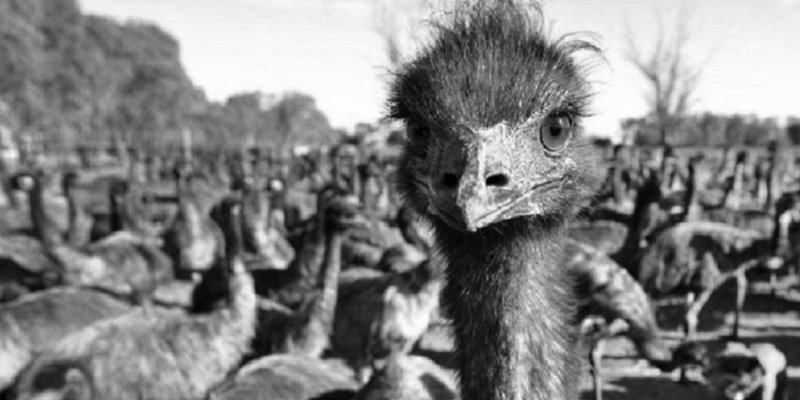
Aug
Background: The Rise of the Emu Population (Or: How Australia Accidentally Created an Army of Feathered Terrorists)
Picture this: It’s the 1920s. World War I just wrapped up, and Australia’s like, “You know what our war veterans deserve? FARMS!” Which, honestly, sounds pretty nice. Fresh air, honest work, maybe grow some wheat, live the dream.
Except nobody bothered to ask the emus how they felt about this plan.
See, in the aftermath of World War I, Australia experienced some significant changes in its agricultural landscape. Returning soldiers were looking to reintegrate into civilian life, and the government had this brilliant idea to offer land concessions. “Here’s some land! Become farmers! What could possibly go wrong?”
As these well-intentioned veterans started clearing land and adopting modern farming techniques, they inadvertently created something spectacular: an all-you-can-eat buffet for emus. These six-foot-tall, flightless birds took one look at the endless fields of grain and thought, “Is this for us? This must be for us. Thanks, humans!”
Now, if you’ve never met an emu, let me paint you a picture. Imagine if a velociraptor and an ostrich had a baby, and that baby grew up with zero fear and a serious attitude problem. Emus are basically nature’s way of saying, “You think you’re tough? Hold my beer.”
These birds are SEED-EATERS, which means all those beautiful wheat fields the farmers were lovingly cultivating? Yeah, that was basically an invitation to the world’s worst dinner party. The emu population exploded. We’re talking about an exponential increase in their numbers—which is a fancy way of saying there were suddenly A LOT of these feathered menaces running around.
The emus learned to take advantage of this cornucopia of resources (that’s “free food” for those of us who don’t use fancy words), and they did what any reasonable bird would do: they invited all their friends. By 1932, an estimated 20,000 emus were living their best lives, treating farmland like an all-inclusive resort.
But here’s where the harmonious coexistence between agriculture and wildlife began to fracture. And by “fracture,” I mean “completely fall apart in the most spectacular way possible.”
The emus weren’t just eating crops—oh no, that would be too simple. They were uprooting plants, trampling seedlings, destroying fences, and basically throwing the world’s most destructive rave across Western Australia. Farmers watched in horror as their entire livelihoods got demolished by birds that couldn’t even fly.
Let that sink in for a moment. Flightless birds. Causing mass destruction.
The economic distress for farmers became increasingly pronounced, which is historian-speak for “everyone was losing their minds.” The farmers tried everything: fences, scarecrows, aggressive shouting. Nothing worked. Emus, it turns out, don’t respond to angry humans the way other animals do. They just stare at you with those cold, dead eyes and continue munching on your wheat.
Desperate times called for desperate measures. The farmers called up the government and basically said, “Hey, remember how we fought for you in World War I? Well, we need you to return the favor. We need military intervention.”
“Against what?” the government asked.
“Birds.”
“…Come again?”
“BIRDS. BIG ONES. SEND HELP.”
And thus, the stage was set for what would become the most hilariously embarrassing military operation in modern history.
The Government’s Response: Declaring War on Emus (Or: When “Send in the Army” Seems Like a Good Idea)
In late 1932, the Australian government looked at the situation and thought, “You know what this agricultural problem needs? MACHINE GUNS.”
Faced with the burgeoning population of emus wreaking havoc on agricultural lands in Western Australia, particularly in the Campion district, the government made what can only be described as a choice. Not necessarily a good choice, but definitely a choice.
They declared war. On birds. Actual, legitimate war.
Let me repeat that for emphasis: The Australian government looked at a flock of flightless birds and said, “This is a job for THE MILITARY.”
Now, the declaration of war was not taken lightly—it was a reflection of the desperation felt by rural communities that found themselves outmatched by nature. Which is a polite way of saying the farmers were absolutely losing it and the government felt pressured to do something dramatic.
Enter Major G.P.W. Meredith, a man whose name would soon become synonymous with “defeated by birds.” The Major arrived with soldiers, military-grade equipment, and two Lewis machine guns. MACHINE GUNS. For birds. I cannot stress this enough.
The government’s logic went something like this: “Emus are tough, but surely they’re no match for automatic weapons operated by trained soldiers who survived World War I. This’ll be quick and easy!”
This decision illustrated the government’s commitment to protecting agricultural interests, but it also illustrated something else: humans have a fascinating tendency to drastically overestimate their ability to solve ecological problems with violence.
The use of soldiers in an agricultural conflict was met with mixed reactions from the public. Some people were supportive, thinking, “Yeah, finally! Show those birds who’s boss!” Others immediately recognized this for what it was: complete and utter insanity.
And you know what? The skeptics were right.
The absurdity of a military campaign against wildlife was not lost on everyone. As reports started rolling in about emus outsmarting soldiers and evading gunfire like they were auditioning for The Matrix, the public reaction shifted from support to something between amusement and secondhand embarrassment.
“How are the emus doing this?” people wondered.
“Are they… organizing?”
“Did the emus appoint generals?”
The military’s efforts failed to yield the desired results, which is a massive understatement. This wasn’t just a failure—this was a masterclass in how NOT to solve a problem. It underscored the complexities of human intervention in wildlife affairs and raised some serious questions about the effectiveness of such measures.
Questions like: “What were we thinking?” and “Can we pretend this never happened?” and “Are the emus going to write a book about this?”
Ultimately, the Australian government’s response to the emu invasion highlighted the tension between agricultural needs and wildlife management. But more importantly, it highlighted that sometimes the solution to a problem is NOT sending in the army to shoot it.
Who knew?
The ‘Battle’ Begins: Military Engagements with Emus (Or: How Trained Soldiers Got Schooled by Birds)
The Great Emu War of 1932 is remembered not only for its unusual combatants but also for being one of the most spectacularly unsuccessful military operations in human history. And that’s really saying something, because humans have a long history of unsuccessful military operations.
When Australian farmers faced unprecedented destruction of crops by emus, the government deployed soldiers armed with machine guns. The soldiers arrived confident, professional, and ready to handle some birds.
The emus were unimpressed.
The engagements, initiated near Campion in Western Australia, revealed some unexpected challenges. Challenges like: “The emus are faster than we thought,” “The emus are harder to hit than we anticipated,” and “Oh God, why won’t they die?!”
See, soldiers soon discovered that emus were surprisingly resilient and swift. “Surprisingly resilient” is putting it mildly. These birds could take multiple bullets and just… keep going. Like terminator birds. Termi-emus, if you will.
As the troops began their operations, they encountered immediate difficulties. Emus would dash in unpredictable directions at high speeds—up to 30 miles per hour, which is faster than Usain Bolt, by the way—rendering the soldiers’ precision aim nearly futile.
Let me paint you a picture of the first major assault. The soldiers spot about 50 emus. Perfect! They set up their machine guns, take careful aim, and open fire.
RATATATATAT
When the smoke cleared, they’d killed approximately… 12 emus.
Twelve. Out of fifty. With machine guns.
That’s a 24% success rate, folks. I’ve had better accuracy throwing darts blindfolded while riding a unicycle.
The remaining 38 emus scattered in different directions like they’d studied military strategy. Some observers genuinely suggested that the emus were using guerrilla warfare tactics. GUERRILLA. WARFARE. TACTICS. By birds.
One encounter perfectly captures the absurdity of this conflict. A group of soldiers strategically positioned themselves for an ambush, only to be outsmarted by a flock of emus that approached from the rear. THE REAR! The emus flanked them!
The soldiers’ reactions oscillated between frustration and hilarity as they found themselves unable to keep pace with the quick-footed birds. Can you imagine having to report back to your commanding officer: “Sir, the emus… they flanked us.”
“They what?”
“They flanked us, sir.”
“…Get out of my office.”
But wait, it gets better.
On day two, the military heard that emus were gathering near a local dam. Brilliant! The emus would be trapped with their backs to the water! This time, victory was assured!
The soldiers set up their ambush. The emus approached. The soldiers opened fire.
And then… the gun jammed.
THE GUN JAMMED.
Approximately 1,000 emus walked away from that encounter. Zero casualties. The emus probably discussed among themselves how pathetic this whole situation was.
“Did you see their faces?”
“Classic humans. All that technology and they can’t even maintain their weapons.”
“Should we feel bad?”
“Nah.”
During one particularly memorable incident, emus demonstrated a baffling knack for weaving through bushes and evading incoming fire with moves that would make action movie stars jealous. Soldiers stood there in disbelief, watching birds dodge bullets.
After a week of this absolute circus, the soldiers had fired thousands of rounds and killed somewhere between 50 to 200 emus. Reports vary because honestly, everyone was too embarrassed to keep accurate count.
The press caught wind of this disaster, and the jokes started rolling in. Newspapers across Australia had a field day. One ornithologist was quoted saying that the emus had “developed guerrilla warfare tactics”—an actual quote about actual birds.
Another observer noted that each emu seemed to have been assigned its own “bodyguard,” implying that the emus were so hard to kill it took multiple soldiers just to target one bird.
Major Meredith, trying to maintain some dignity, reported back that the emus were “remarkably clever” and that their tactics were “most interesting.”
Translation: “These birds are making us look like absolute fools, and I have no idea what to do about it. Please send help. Or let me retire. Preferably both.”
This stark juxtaposition of military protocol against the backdrop of nature’s stubborn inhabitants punctuates the surreal nature of the Great Emu War. It’s the kind of thing that sounds made up but is 100% historically accurate.
Ultimately, this whimsical conflict serves as a testament to the unpredictability of both nature and human hubris. It also serves as a reminder that just because you have the biggest guns doesn’t mean you’re going to win.
Especially when your enemy is a six-foot-tall bird with the tactical awareness of a special ops unit and the durability of a tank.
The Outcome: A Humiliating Defeat and Its Legacy (Or: How to Lose a War to Birds and Learn to Laugh About It)
The Great Emu War ended exactly how you’d expect a war against bulletproof birds to end: badly for the humans.
After several months of military operations involving soldiers armed with machine guns, it became increasingly clear that the emus had not only survived but had absolutely dominated every engagement. The authorities ceased operations in mid-November 1932, recognizing that these large birds were not only resilient but also apparently smarter than military strategists.
Let’s talk numbers. The military came with 10,000 rounds of ammunition to deal with 20,000 emus. Final tally? They killed approximately 986 emus.
That’s less than 5% of the emu population. They used nearly 10,000 bullets to kill less than 1,000 birds. The emu-to-bullet ratio was roughly 10 rounds per bird. For comparison, a decent hunter can take down a deer with one or two bullets.
The emus won. Decisively. Overwhelmingly. Embarrassingly.
The chagrin surrounding this outcome propelled discussions on the efficacy of military interventions in managing wildlife populations. By “discussions,” I mean people asking, “What the hell were we thinking?” and “Can we please never speak of this again?”
But the repercussions extended far beyond the immediate embarrassment faced by the Australian military—though that embarrassment was SUBSTANTIAL. The failed attempts to manage emu numbers underscored the challenges of integrating modern agricultural practices with wildlife management strategies.
For farmers in Western Australia, the realization that conventional means of pest control were inadequate forced a critical reassessment. Like, “Maybe we shouldn’t just shoot at our problems” kind of reassessment. Revolutionary stuff.
This incident brought to light the need for a better understanding of ecosystems and led to the development of alternative strategies to mitigate wildlife impacts on agriculture. Strategies that actually worked, by the way.
The government eventually started a bounty system, paying locals for emu kills. Over the next few years, bounty hunters killed more than 57,000 emus. FIFTY-SEVEN THOUSAND. Compared to the military’s 986.
It’s almost like local hunters who understood the terrain and emu behavior were more effective than soldiers following military protocol. Who could have predicted that?! (Everyone. Everyone could have predicted that.)
They also implemented better fencing strategies and studied emu migration patterns. You know, smart solutions instead of just “shoot it until it stops moving” solutions.
But here’s where the story gets actually wholesome: Australia embraced the failure.
The Great Emu War has since entered the annals of Australian popular culture, symbolizing both an unintended farcical episode and a lesson in humility. Instead of trying to bury this embarrassing chapter in history, Australians turned it into a source of national humor.
Because here’s the thing about Australians—they live on a continent where literally everything is trying to kill them. Spiders, snakes, jellyfish, cassowaries, and apparently, emus. They’ve developed a sense of humor about these things out of sheer necessity.
So when they lost a war to birds, they basically went, “Yeah, that happened. The emus were tougher than we thought. Fair play to them, honestly.”
Today, you can visit Western Australia and take Emu War Tours. TOURS. Of the battlefields where absolutely nothing of significance happened except the systematic humiliation of the Australian military.
The emus, for their part, are now on Australia’s coat of arms. Let me repeat that: Australia put the animal that defeated their military on their national emblem. That’s some next-level “we own our failures” energy, and honestly? We should all aspire to that.
It’s like if Germany put cheese on their coat of arms after losing to France. Except this actually happened.
The narrative of man versus nature remains a recurring theme in historical discourse, often cited in discussions about human intervention in ecological matters. To this day, the event has become a source of irony and humor, reflecting the broader discourse on wildlife management strategies and the complexity of agricultural interactions with nature.
As historians and scholars continue to delve into this unusual chapter, the lessons learned serve as a reminder of the enduring relationship between humankind and the wild. Lessons like:
- You can’t just shoot your way out of ecological problems
- Nature is always more adaptable than you think
- Local knowledge beats military might in pest control
- Emus are borderline indestructible
- Sometimes you have to laugh at yourself
The Great Emu War of 1932 stands as a testament to human hubris, the unpredictability of nature, and the importance of not taking yourself too seriously when you lose a war to birds.
The emus are still out there, by the way. Living their best lives. Eating crops occasionally. Telling their grandchildren stories about that one time they defeated the entire Australian military.
And honestly? They earned it.
Final Thoughts
So the next time you see an emu at a zoo, show some respect. Those are battle-hardened veterans who have defeated human military forces. They are undefeated in warfare, and they want you to know it.
The Great Emu War remains one of the most bizarre, hilarious, and surprisingly educational moments in military history. It’s a story about the limits of human power, the resilience of nature, and what happens when you try to solve an ecological problem with machine guns.
Spoiler alert: It doesn’t work.
But hey, at least Australia got a great story out of it. And the emus got bragging rights for eternity.
Never underestimate a bird that can’t fly. Especially if that bird is Australian.
Key Takeaways:
- In 1932, Australia declared actual war on 20,000 emus
- The military brought machine guns. The emus brought attitude.
- Final score: Emus – 1, Australian Military – 0
- The emus are now on Australia’s coat of arms
- Nature always wins, and sometimes it wins hilariously
Fun Fact: The emus were so successful that some military historians study the Great Emu War as an example of how guerrilla tactics can defeat a superior force. Yes, bird tactics are taught in military courses. Let that sink in.
Have you heard of other ridiculous human vs. animal conflicts? Drop them in the comments! And if you enjoyed this deep dive into one of history’s most absurd moments, share it with someone who needs a laugh today. The emus would want you to.


Nature and Wildlife
Polygon Raccoon Face – Unisex T-Shirt – Clever, Curious, and Cool


Nature and Wildlife


Environmental


Nature and Wildlife
Aloe You Vera Much – Unisex T-Shirt – Plant Love Is the Best Love


Funny and Sarcastic


Funny and Sarcastic
Murder Hornets – Unisex T-Shirt – Apparently the Stinger Wasn’t Enough


Nature and Wildlife


Environmental
